
Business & ESG
Why we are publishing product carbon footprints
A carbon number isn't a sustainability score. But it can tell us something useful. Here's why we're putting product carbon information where people can actually see it.
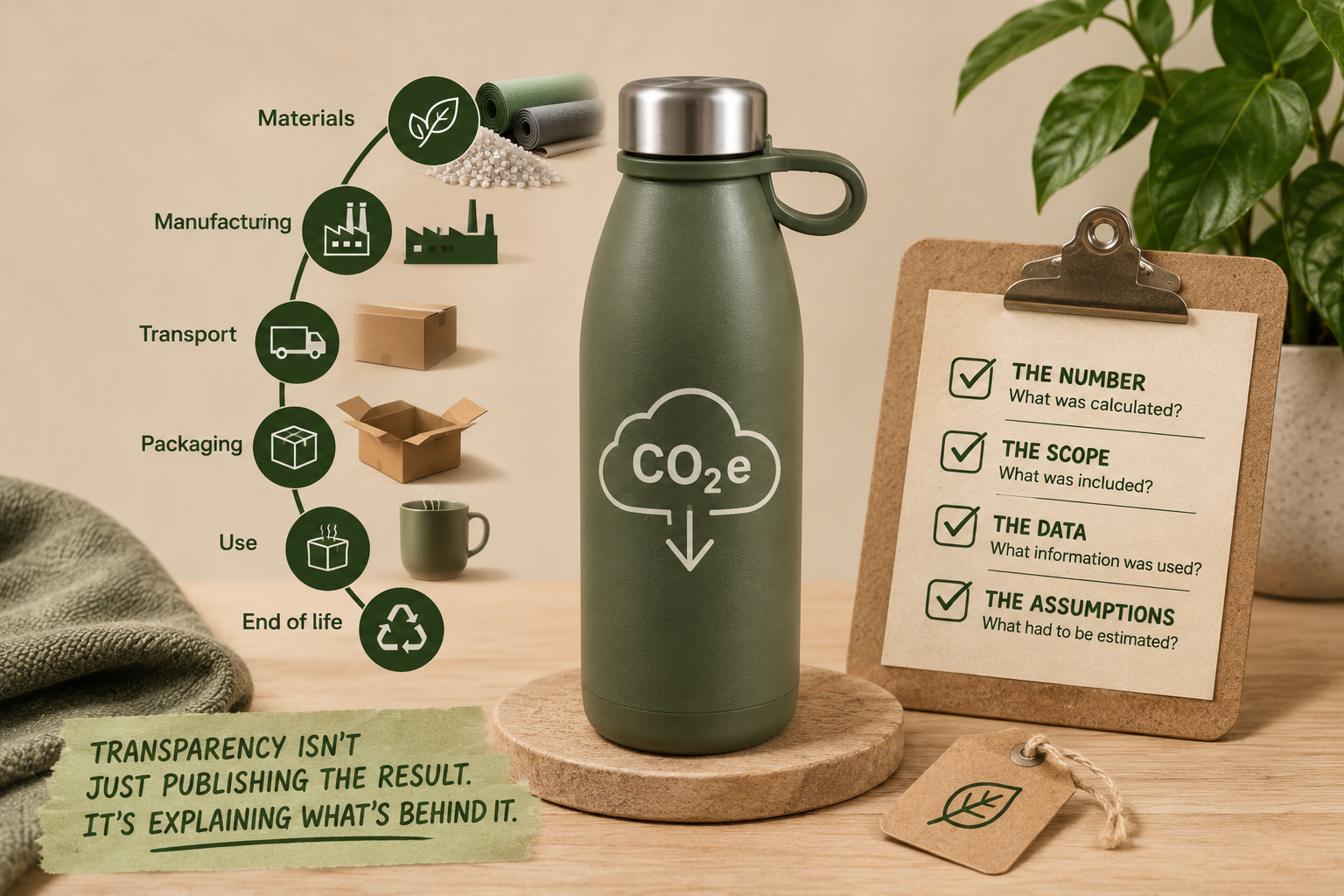
There's a number appearing on more of our product information.
kg CO₂e
At first glance, it looks wonderfully scientific. Precise, even.
Which immediately creates a problem.
Because a product carbon footprint isn't a magic sustainability score. It doesn't tell you whether a product is "good". It doesn't tell you whether another product is "bad". And it definitely doesn't squeeze every environmental and social consideration into one convenient little number.
So why are we publishing it?
Because we'd rather give you more useful information than another vague green claim.
Let's explain.
First: what exactly are we showing?
A product carbon footprint estimates the greenhouse gas emissions associated with a product across the lifecycle stages included within the calculation.
Those emissions are commonly expressed as kg CO₂e.
That little e matters. It stands for equivalent.
Different greenhouse gases have different effects on the climate, so carbon dioxide equivalent provides a common way of expressing their climate impact.
Which sounds complicated. Thankfully, you don't need a climate-science degree to use the information.
Wait... what does that mean?
Carbon dioxide equivalent
A way of expressing the climate impact of different greenhouse gases using one common measurement.
CO₂e lets different greenhouse gases be represented using a comparable carbon-dioxide-equivalent value.
Explore SustainabilityOkay. That wasn't so painful.
Why put the number on the product page?
Because that's where decisions are being made.
Sustainability information isn't particularly useful when it's hidden inside a report nobody sees.
If you're comparing a bottle, a bag, a notebook or a piece of technology, product-level information should ideally sit close to the product itself.
That's why we're working towards bringing material information, certifications, sustainability attributes and carbon information together. Not in a separate sustainability universe. Right where you're sourcing.
Because "eco-friendly" doesn't tell you very much
You've probably noticed we're not huge fans of vague environmental language.
Eco-friendly. Green. Planet friendly. Environmentally responsible.
They sound reassuring. But reassuring isn't the same thing as informative.
Vague versus specific
"This is an eco-friendly bottle."
Sounds good. Tells you almost nothing about what was measured.
"This product has a calculated carbon footprint of X kg CO₂e using the stated methodology and scope."
Doesn't tell you everything, but it tells you what is actually being measured.
The second statement is a much better place to start a conversation.
A CARBON NUMBER ISN'T A SUSTAINABILITY SCORE.
Quick myth buster
"The product with the lowest carbon number is automatically the most sustainable product."
Carbon footprint information measures a particular type of environmental impact within a defined methodology and scope. It doesn't automatically account for every consideration such as product longevity, usefulness, repairability, material circularity, social impacts or what ultimately happens to the product. Carbon is part of the story. Not the whole story.
Explore SustainabilitySo what goes into a product carbon footprint?
This is where the word scope becomes important.
A carbon footprint calculation depends on which lifecycle stages are included and what data and assumptions are used.
Depending on the methodology, those stages can include things such as:
Look behind the number
Lifecycle areas a calculation may include. Explanatory only — no values, no percentages.
- 1
Materials
The materials and components used to make the product.
- 2
Manufacturing
The processes and energy associated with production.
- 3
Transport
Movement of materials and/or finished products within the defined calculation boundary.
- 4
Packaging
Packaging included within the methodology.
- 5
Use
Relevant impacts during product use where applicable and included.
- 6
End of life
Assumptions about what happens when the product is no longer used, where this falls within the calculation scope.
But here's the important part: never assume all product carbon footprints include exactly the same things.
Methodology matters. Boundaries matter. Data matters. Assumptions matter.
A carbon number without context is just... a number
Imagine seeing a figure sitting on its own.
Is that high? Low? Good? Bad? Compared with what? Calculated how? What stages were included? What assumptions were made?
Without context, the apparent precision of the number can be misleading.
That's why we think carbon information should be accompanied by information about how the number was produced.
Four things worth knowing
The number
What was calculated?
The scope
What was included?
The data
What information was used?
The assumptions
What had to be estimated?
TRANSPARENCY ISN'T JUST PUBLISHING THE RESULT. IT'S EXPLAINING WHAT'S BEHIND IT.
Estimates aren't the enemy
Product carbon footprints often rely on a combination of available product information, emissions factors, modelling and assumptions.
That means a calculated footprint should not necessarily be interpreted as a perfectly measured record of every molecule emitted while making that exact item.
And that's okay.
Models and estimates can still be useful when their methodology, assumptions and limitations are understood.
The goal isn't to make the number look more certain than it is. The goal is to make the information useful and transparent enough to understand.
Why not wait until the data is perfect?
Because we'd probably be waiting a very long time.
Supply chains are complicated. Products contain multiple materials and components. Manufacturing data varies. Logistics routes change. Data quality improves. Methodologies evolve.
If the standard for sharing information is "we will only publish something once every single input is perfect forever", we won't get very far.
We'd rather take a different approach: use the best available information, explain the methodology, identify assumptions, and improve the data when better information becomes available.
That's not a weakness. That's what transparency looks like.
Better data should lead to better questions
Instead of asking "which product has the green leaf icon?", we can start asking:
What are the biggest contributors to this product's footprint? Is it the material? Manufacturing? Transport? Packaging? Could the order quantity change the logistics impact? Could a different material change the result? How long is the product likely to remain useful?
Suddenly sustainability stops being a badge. It becomes a conversation about trade-offs.
That's considerably more useful.
Hotspots can be more useful than the headline number
One of the reasons we like showing carbon information is the ability to look beyond the total.
A footprint can help identify areas contributing more heavily to the calculated result. These are often described as hotspots.
If materials dominate the footprint, that's useful information. If transport is significant, that's useful information. If another lifecycle stage contributes heavily, that's useful too.
Because once you understand where the impact is occurring, you can start asking more informed questions.
A NUMBER TELLS YOU HOW MUCH. A HOTSPOT CAN HELP YOU ASK WHY.
And yes, AI can help with this
Some of the tools we use to structure, process and present sustainability information can use AI-assisted technology.
But AI doesn't get to magically declare a product sustainable. Nor should it.
AI can help organise information, interpret structured inputs, identify patterns and make complex data easier to understand. The quality of the output still depends heavily on the quality of the underlying data, methodology and assumptions.
AI is a tool in the process — not the evidence behind the claim. That distinction matters.
We're not trying to give products a green score
We deliberately don't want this to become a "9.4 out of 10 — very green!" badge. That's not what a carbon footprint is.
A recycled-content percentage tells you something about recycled content. A certification tells you something according to the scope of that certification. A carbon footprint tells you something about calculated greenhouse gas emissions. Product longevity tells you something else.
These pieces can help build a more informed picture. But they shouldn't be blended into an invented sustainability score simply because one number is easier to market.
Can you compare two product footprints?
Sometimes. But comparison requires care.
For two carbon-footprint numbers to be meaningfully compared, you need to understand whether they were calculated using compatible methodologies, lifecycle boundaries, assumptions and units.
Two numbers sitting next to each other don't automatically make them directly comparable.
That's why we don't want customers thinking one figure simply beats another and the decision is done.
Context first. Comparison second.
What we want this information to do
We don't expect somebody to choose promotional merchandise based on one carbon number. We hope it does something more useful.
We hope it helps resellers ask better questions, have better conversations with clients, understand product hotspots, look beyond vague sustainability language, consider materials, longevity and impact together, and communicate what is actually known rather than what sounds good.
That's the point.
Transparency beats perfection
Sustainability is an area where businesses can become terrified of saying anything. Say too much and you risk overclaiming. Say too little and useful information stays hidden.
Our approach is relatively simple: show what we know, explain what it means, be clear about what it doesn't mean, and improve it when better information becomes available.
We think that's a much healthier direction than pretending every product can be divided neatly into good and bad. Real products are more complicated than that. So are supply chains. And that's okay.
The takeaway
We're publishing product carbon footprints because better decisions need better information.
Not because carbon tells us everything. It doesn't. Not because every calculation is perfect. It isn't. And not because we want to stick another green badge on a product. We don't.
We're doing it because specific information is more useful than vague claims, methodology should be visible, assumptions should be acknowledged, and better data should improve the conversation.
Where this leads
Better data
Best available information, with the methodology and assumptions stated.
Better questions
Where is the impact, and what could change it?
Better decisions
Choices made on evidence rather than adjectives.
And perhaps most importantly: a carbon footprint should help you ask better questions — not stop asking them.