
Behind the Materials
What Recycled Content Claims Actually Mean
10% recycled. 50% recycled. 100% recycled. Post-consumer. Pre-consumer. Certified recycled content. There can be a lot hiding behind one little word. Let's unpack what recycled-content claims are actually telling us.
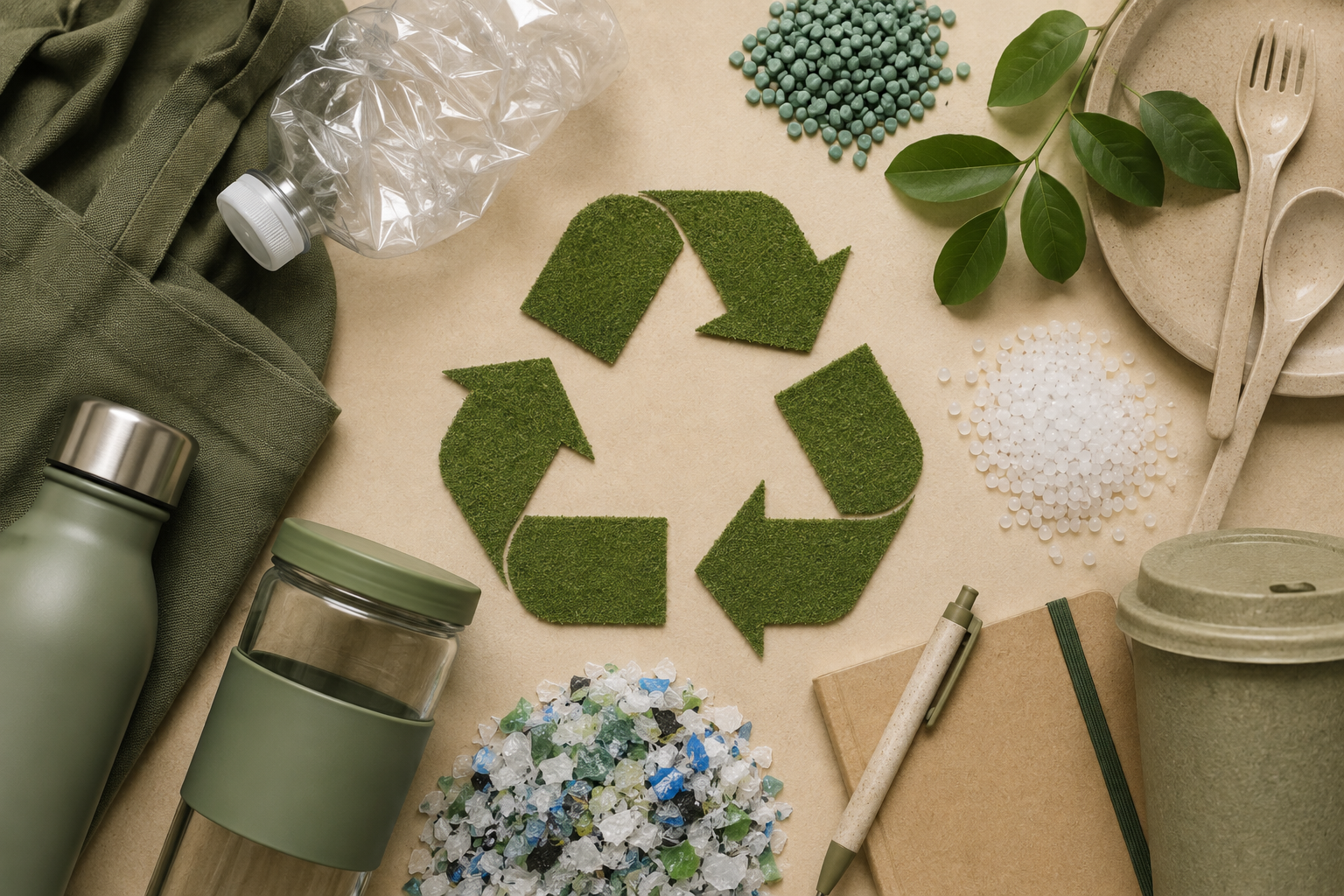
You see a product labelled:
MADE WITH RECYCLED MATERIAL
Sounds straightforward.
Except... how much? 10%? 50%? 100%? The entire product? Just the main fabric? And where did that recycled material come from?
Suddenly one very reassuring word has created quite a few questions.
Welcome to the surprisingly complicated world of recycled-content claims. Don't worry. We're going to make it considerably less complicated.
Let's start with "recycled content"
Recycled content generally refers to material that has been recovered or diverted from the waste stream and used again in a product or material. Instead of all of the material coming from virgin raw-material inputs, some or all of it comes from recovered material.
So far, so good. But here's the important part: the word "recycled" doesn't automatically mean 100% recycled.
If only part of a product or material contains recycled content, the percentage and what the claim applies to become important pieces of information.
There's quite a difference between "contains recycled material" and "main fabric contains 70% recycled polyester." The second one actually tells us something measurable.
10%, 50%, 100% — the number matters
Imagine three products. All three can legitimately involve recycled content if those claims are properly supported. But they clearly aren't making the same claim.
Illustrative examples only
20%
Recycled content
60%
Recycled content
100%*
Recycled content in the claimed component
*Always check what material or component the percentage refers to. These figures are educational examples, not claims about specific Ecosource products.
That's why simply putting a giant RECYCLED badge next to all three can remove some very useful information. Where a verified percentage is available, showing it can give buyers a much clearer understanding of what they're looking at.
Quick myth buster
"Recycled means 100% recycled."
Not necessarily. A product can contain a proportion of recycled material alongside other material. A recycled-content claim should be understood according to the percentage, material or component it actually covers. One word. Potentially very different percentages.
Explore the Material GuideThe claim might not apply to the whole product
This is where promotional merchandise gets particularly interesting. Most products aren't made from one single thing.
Take a backpack. It might have a main outer fabric, lining, zips, buckles, webbing, padding, thread and labels.
If the main fabric contains recycled polyester, that doesn't automatically mean every zip, buckle and centimetre of thread does too. The same applies to drink bottles, notebooks, pens, technology products and plenty of other merchandise.
A recycled-content claim might apply to the entire product, a particular material, a specific component, or the packaging. Those aren't interchangeable.
Wait... what does that mean?
Post-consumer recycled content
Material recovered after it has been used by the end user and then processed for another use. Think of material entering a recovery stream after serving its original consumer purpose.
The important bit is when it entered that recovery journey: after consumer use.
Explore the Material GuideAnd what is pre-consumer recycled content?
Pre-consumer recycled material comes from material recovered during manufacturing before the finished product reaches a consumer. For example, suitable manufacturing offcuts or production material might be recovered and processed rather than discarded.
Two different sources
Post-consumer
Recovered after consumer use.
Pre-consumer
Recovered from the manufacturing stream before consumer use.
Both can contribute to recycled content. They simply describe different sources.
Why does everyone keep talking about plastic bottles?
Because they're an easy example. A used PET bottle can potentially enter a recycling stream, be processed into recycled PET — often called rPET — and that material can then be used in another product.
You might find rPET in bags, backpacks, textiles, umbrellas, accessories or selected product components.
Which leads to one of those sustainability phrases that sounds strange until you understand it: "this bag is made using recycled bottles."
Usually, nobody has stitched a collection of drink bottles together and added shoulder straps. The recovered PET has been processed into material suitable for manufacturing something new.
Much less dramatic. Considerably more accurate.
Does recycled content mean recyclable?
No. And this distinction is worth repeating.
Same recycling family, different part of the story
Recycled
What went into it? Material that was recovered and used to make the product.
Recyclable
What can potentially happen after use? Whether the product or material can practically be recycled at end of life.
A product can contain recycled material and still be difficult or impractical to recycle at end of life. Multiple materials, adhesives, coatings, construction and available recycling infrastructure can all affect that.
Recycled does not automatically mean recyclable.
What does "certified recycled content" add?
This is where standards such as GRS and RCS can become relevant. Certification can provide additional verification around recycled material and its movement through the supply chain.
But — because apparently sustainability refuses to give us one-word answers — different standards have different scopes and requirements. Certification should therefore be understood according to the actual standard and claim associated with the product.
We've covered that properly in another Eco Edit story rather than turning this article into Acronym Soup: Part Two.
So is 100% recycled automatically the best option?
Tempting, isn't it? 20% recycled. 50% recycled. 100% recycled. Surely we just choose the biggest number.
Except product sustainability isn't a game of Top Trumps. Recycled-content percentage tells us something useful about one attribute of the product.
It doesn't automatically tell us how long the product will last, how useful it will be, how it was manufactured, how far it travelled, how easily it can be repaired, what packaging was used, what happens at end of life, or its overall environmental impact.
A higher recycled-content percentage may be relevant to a purchasing decision. It just isn't a universal sustainability score.
Another number worth looking at: the actual quantity
Here's where things become more useful for buyers. If you're ordering 1,000 units of a product, the recycled-content claim isn't just a badge on an individual item. It applies across an entire order.
Understanding what material contains recycled content, what percentage is recycled, and how much of that material is in each product can provide considerably more context than simply seeing a recycled icon.
This is also why good product data matters. Better inputs allow for better conversations.
Be careful with the jump from "recycled" to "sustainable"
Here's a sentence we should probably put on a sticky note.
A material attribute is not the same thing as an overall sustainability verdict.
Recycled content can be an important and useful attribute. But saying "this contains 60% recycled polyester" is very different from saying "this is a sustainable product."
The first is a specific claim that can potentially be verified. The second tries to summarise an enormous range of environmental and social considerations in one word.
Specific wins. Almost every time.
What should I look for when sourcing?
You don't need to interrogate every promotional bottle like it's under investigation. Just look for a few useful pieces of information.
Six questions worth asking
- 1
What material?
What is actually described as recycled?
- 2
What percentage?
Is the amount of recycled content provided?
- 3
Which component?
Does the claim apply to the whole product or one part?
- 4
What type?
Is the material identified as pre-consumer, post-consumer or simply recycled content?
- 5
Is it certified?
Is a relevant certification or supporting document available?
- 6
What do we actually know?
Perhaps the most important question of all. Don't fill gaps in the information with assumptions.
The sentence we'd rather see
Compare "eco-friendly bag" with "main fabric contains 70% certified recycled polyester."
The second statement might sound less exciting. But it's much more useful. It tells the reseller something. It tells the customer something. And — most importantly — it gives us a claim we can actually explain.
Sustainability communication doesn't necessarily need bigger claims. It needs better information.
The takeaway
When you see recycled content, don't stop at the word recycled.
Four things worth checking
- 1
What?
Which material or component does the claim cover?
- 2
How much?
What's the recycled-content percentage, where available?
- 3
Where from?
Is information about the source of the recycled material available?
- 4
Verified how?
Is there relevant certification or supporting information?
And if some of that information isn't available? That's okay too.
Say what you know. Don't invent what you don't.
Because "contains 50% recycled material" might not sound quite as glamorous as "saving the planet one bottle at a time." But it's considerably more useful. And considerably easier to stand behind.
Want to dig a little deeper?
Material Guide
Understand more about the materials used across the Ecosource range.
Explore MaterialsCertifications
Learn what different certifications and standards represent.
Explore CertificationsProducts
Browse the Ecosource range with material, certification and carbon information.
Explore Products