
Business & ESG
ESG Without the Alphabet Soup
Everyone's talking about ESG. But what does it actually mean — and why should anyone in promotional merchandise care?
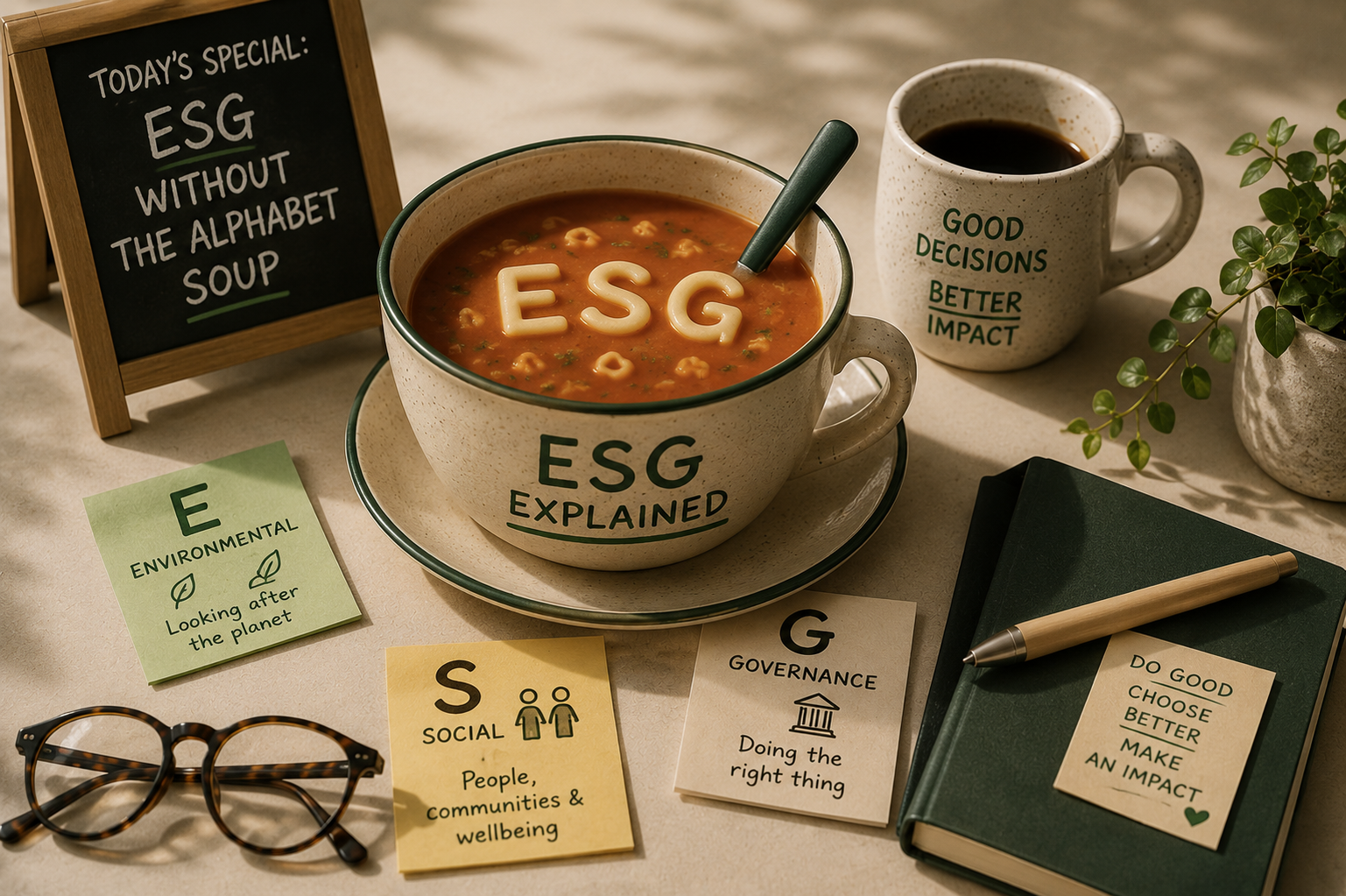
ESG.
Three little letters that somehow manage to make perfectly normal conversations sound like they require a boardroom, a 70-page report and at least one complicated spreadsheet.
But underneath all the corporate language, the idea is actually much easier to understand.
ESG stands for Environmental, Social and Governance.
It's a way of looking beyond what a business sells or how much money it makes and asking broader questions about how it operates, the impact it has, and how responsibly it is run.
And yes — it has something to do with promotional merchandise too.
So, coffee ready? Let's unpack it without the alphabet soup.
First things first: what does ESG actually mean?
Think of ESG as three different lenses through which a business can be considered.
E is for Environmental
This is probably the part most people immediately associate with sustainability.
It can include things such as greenhouse gas emissions, energy use, waste, materials and resources, packaging, water use, pollution and climate-related impacts.
In the world of promotional merchandise, environmental considerations might include what a product is made from, whether recycled material is used, how much packaging it has, where it travels from and what happens to it at the end of its useful life.
But environmental sustainability is rarely as simple as finding a product with the word "eco" in its description.
More on that shortly.
S is for Social
This is the people part.
Social considerations can include working conditions, labour practices, human rights, health and safety, diversity, communities and how businesses interact with employees, suppliers and customers.
For merchandise, that means thinking beyond the physical product.
A reusable bottle may have impressive material credentials, for example, but responsible sourcing also involves questions about the supply chain and the conditions under which products are manufactured.
G is for Governance
Governance is essentially about how a business is managed and held accountable.
It can cover things such as policies, ethics, transparency, risk management, compliance and decision-making.
It may sound like the least exciting member of the ESG family, but governance is what helps turn good intentions into actual business practices.
Because saying "sustainability matters to us" is easy.
Having systems, policies, information and evidence behind that statement is the harder part.
Wait... what does that mean?
Environmental, Social & Governance
A framework used to consider environmental and social factors alongside how an organisation is managed and governed.
See? Three letters. Much less scary now.
Explore our approach to sustainabilityWhy is everyone suddenly talking about ESG?
ESG conversations have become much more visible because businesses are being asked more questions about their environmental and social impacts.
Customers are asking. Procurement teams are asking. Investors and stakeholders may be asking. Supply-chain partners are asking.
And depending on the organisation, industry and jurisdiction, there may also be reporting or disclosure requirements to consider.
That means businesses increasingly need better information about the products and services they purchase.
Promotional merchandise may only represent one small part of a company's overall purchasing activity, but it is still purchasing.
Which leads us to the interesting bit.
What on earth does ESG have to do with promotional merchandise?
Quite a lot, actually.
Imagine a company ordering 5,000 promotional items for an event.
Traditionally, the conversation might have been: What does it cost? Can we put our logo on it? Can we get it by Friday?
All still very important questions.
ESG thinking simply encourages a few more. What is it made from? Does it contain recycled material? Are there relevant certifications or standards? Where is it manufactured? How far does it need to travel? Is it useful enough that somebody will actually keep it? Do we have evidence for the sustainability claims we're making about it?
Suddenly the humble promotional product becomes part of a much bigger procurement conversation.
The most sustainable product isn't necessarily the one with the greenest description
This is where things get interesting.
A product being described as recycled, reusable, natural, renewable or biodegradable tells you something about it.
It doesn't necessarily tell you everything.
A recycled product isn't automatically recyclable. A natural material isn't automatically the lowest-impact option. A reusable product only delivers the benefits of reuse if people actually keep and use it.
And a product containing recycled material may contain different percentages or types of recycled content.
Sustainability is usually about understanding the wider picture rather than searching for one magic word.
That's why good product information matters.
Quick myth buster
"Recycled means recyclable."
Not necessarily. A product can contain recycled material without being recyclable at the end of its life. Material combinations, coatings, components and local recycling systems can all affect whether it can actually be recycled.
Explore the Material GuideBetter questions lead to better decisions
Nobody expects the person ordering branded notebooks for a conference to suddenly become a lifecycle-assessment specialist.
Thankfully.
But asking better questions can make a meaningful difference.
Better questions lead to better decisions.
When you're sourcing merchandise, try starting with:
1. What is the product made from? Look beyond the product name and understand the main materials.
2. What does the sustainability claim actually refer to? If something says "recycled", ask what is recycled and, where available, how much.
3. Is there certification or supporting information? Certifications can provide useful additional information, but they also need to be understood in context.
4. Is this product actually useful? A product designed to be reused isn't achieving much sitting untouched in the back of a cupboard. Consider the recipient, the purpose and whether the item is likely to have a useful life beyond the campaign.
5. How much do we really need? Ordering more isn't always better. Thoughtful quantities can help reduce unnecessary surplus merchandise.
6. How will it be branded? Branding is part of the product too. Different decoration methods suit different products, materials, artwork and applications. Understanding those options can help you choose a branding method appropriate for the product.
7. Can we support the claims we're making? This one matters. If you're telling customers that something is recycled, certified or has a particular sustainability attribute, make sure there is information available to support the claim.
Good sustainability communication should help people understand a product — not simply make it sound greener.
Where does Ecosource fit into all of this?
Our role isn't to tell you that one promotional product is magically "good for the planet."
Sustainability is more complicated than that.
What we can do is make useful product information easier to find and understand.
Across Ecosource, we're working to bring together information such as materials, recycled content, certifications, product attributes, branding options and, where available, carbon information.
The goal is simple: give resellers better information so they can ask better questions, have better conversations with their clients and make more informed product choices.
We won't always have every answer.
Supply-chain information varies between products and suppliers, methodologies evolve, and some environmental impacts are much easier to measure than others.
Where information is available, we want to make it useful. Where assumptions or limitations exist, we believe they should be clear.
Because transparency is considerably more useful than another green buzzword.
ESG doesn't have to start with a 70-page report
If ESG still feels enormous, that's because it is.
It covers a huge range of issues, and no single promotional product is going to solve them.
But that doesn't mean merchandise sits outside the conversation.
Better sourcing can start with something surprisingly simple: ask better questions.
What is this made from? Where did this claim come from? Is there evidence? Will somebody actually use this? Do we really need this many?
Those aren't complicated ESG frameworks.
They're simply better purchasing questions.
And that's a pretty good place to start.
Want to dig a little deeper?
Sustainability
How Ecosource approaches materials, certifications, product attributes and impact information.
Explore SustainabilityMaterial Guide
Understand more about the materials used across the Ecosource range.
Explore MaterialsCertifications
Learn what different certifications and standards represent.
Explore CertificationsBranding Guide
Understand the decoration methods available across the Ecosource range.
Explore Branding